
How to Build Functional Strength Without Getting Injured

Getting stronger has always been one of my biggest personal goals, both physically and mentally.
I started with yoga, which kept me moving and helped me reconnect with my body. It taught me awareness, control and how to stay present with discomfort. But deep down, I knew it wasn’t enough for me. I've always had this strong drive to push beyond my current limits, to see what my body was capable of despite of everything.

So when I first stepped into a gym, I was excited… and completely lost.
Like many beginners, I gravitated towards the “safe” machines: hip abductions and adductions, leg press, shoulder press, chest press, and rowing machines. For six months, I followed circuit-style training. And to be fair, the machines did make me stronger. But something felt missing.
My movement felt guided rather than learned. My range of motion stayed limited. I still couldn't squat or deadlifted properly, and big compound movements intimidated me more than I want to admit.
I was getting stronger… but I wasn’t building real functional strength.
While the machines were great to get me started, I eventually realised that my progress was becoming limited. I've always been drawn to challenge, and beyond increasing the weight stack, I felt the need to learn how to move my own body through space, without external guidance.
That realisation completely change the way I approached training. Because strength started to feel different once movement stopped being isolated.
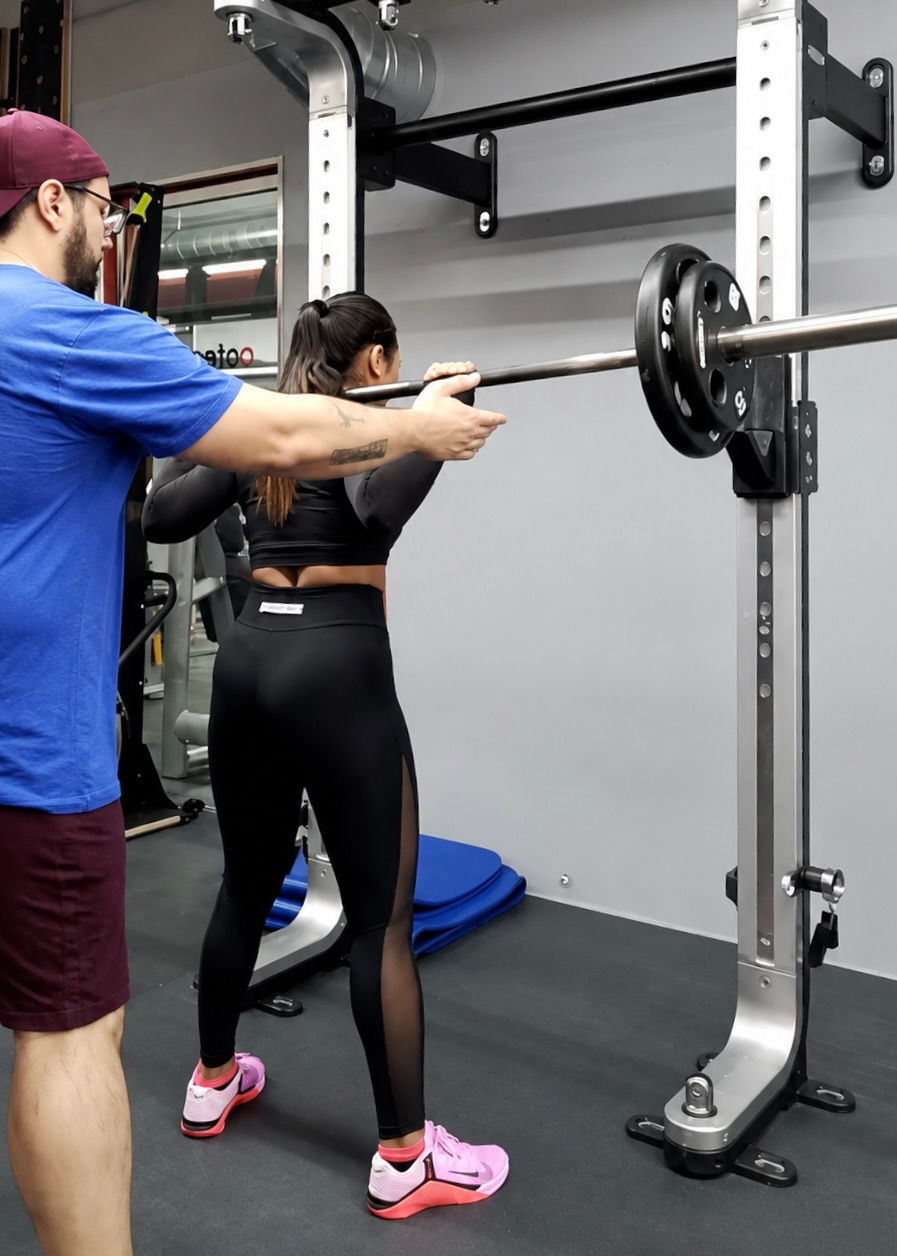
The first time I learned how to squat properly, I realised how much coordination, balance, mobility, and awareness were actually involved in something that looked so simple. The same happened with deadlifts, lunges, and pull-ups. These movements demanded more than muscle. They demanded organisation.
And strangely enough, that's when I began to trust my body more. Not because the movements became easy, but because my body started learning how to support itself instead of relying on the machine to stabilise everything for me.
That changed everything. Eventually, it became the foundations of Rebound.
What Real Functional Strength Actually Means
In my previous article, I explained what makes training truly functional. This time, I want to go one step further and talk about how to actually build that kind of strength, without getting injured along the way.
Real functional strength is the ability to produce force, control your body, and move efficiently in everyday life. Not just in ideal conditions, but when you're tired, off-balance, carrying something awkward, climbing stairs too quickly, or pushing yourself through something demanding, like a HYROX race.
It's easy to mistake strength for how much weight you can move. But real strength goes beyond that. It's the right combination of mobility, stability, force production, and conditioning working together at the right time.
You need enough mobility to move through a full range of motion without compensation. Enough stability, especially through the shoulders, core, and hips, to control that movement. Enough strength to produce and resist force safely. And enough conditioning to sustain effort without everything falling apart the moment fatigue appears.

That’s the difference.
Functional strength improves the way your body organises itself under real-world demands. Every repetition becomes more than just exercise, it becomes practise for how you move through life.
The Most Common Mistakes That Lead to Injury

Over the years, I’ve made almost every mistake possible, including one that cost me months of training.
When I first started chasing pull-ups back in 2020–2023, I was impatient. I skipped proper warm-ups, had almost no scapular control, and used kipping to get myself over the bar. Eventually, I developed shoulder tendinopathy. It was frustrating, but more than that, it made everyday life surprisingly difficult. Something as simple as pulling a t-shirt over my head would make me cringe in pain. At the time, I thought I was simply training hard. Looking back, I realise I was skipping foundations in order to chase the result faster.
That experience taught me more than any certification ever could.

One of the biggest mistakes people make is trying to force advanced movements before building the capacity to support them. Pull-ups, heavy squats, Olympic lifts, handstands... they all look impressive, but without the necessary mobility, stability, and control underneath, the body eventually finds a weak link.
For me, it was the shoulders.
At the time, I was doing far more pushing than pulling, with very little awareness of how my shoulder blades actually moved. I had almost no scapular control, poor overhead stability, and very limited understanding of how the shoulder complex functioned as a system.
That combination is one of the fastest routes to shoulder pain.
Another mistake I made early on was training almost exclusively in fixed planes of motion. Machines gave me structure and confidence, but they also limited variability. I wasn’t rotating, carrying, stabilising, or coordinating movement through space. My body was getting stronger in isolated patterns, but not necessarily more adaptable.
Recovery was another lesson I learned the hard way.
I used to think progress came purely from training harder. But poor sleep, accumulated fatigue, stress, and neglecting mobility work eventually catch up with the body. Recovery is not separate from training. It is part of training.
And perhaps the biggest mistake of all was imbalance.
Too much pushing. Not enough pulling. Too much intensity. Not enough patience.
The good news is that most injuries are rarely caused by a single bad workout. More often, they’re the result of repeated compensations, poor recovery, rushed progression, and ignoring what the body has been trying to communicate for a long time.
Awareness changes that.

Once you understand where these mistakes come from, you stop training just to survive the session, and start training in a way your body can sustain long term.
The 6 Principles of Smart Functional Strength Training
After years of trial and error, injuries, setbacks, and slowly figuring things out, these are the principles that completely changed the way I train and coach today.
1. Start with Scapular Control and Shoulder Stability
This became non-negotiable for me.
Before chasing heavy weights or advanced skills like pull-ups, and even simple movements like reaching the arms overhead, the shoulders need to learn how to stabilise and move well first. Proper scapular control changes everything, from pulling mechanics to overhead stability and even posture.
It’s the foundation I wish I had understood from the beginning.
2. Prioritise Movement Quality Over Weight
I learned this the hard way.
A controlled bodyweight squat or push-up will always be more valuable than a heavy, compensated repetition done without awareness or control. Real strength is built through quality movement, not ego lifting.
The body remembers how you move, not just how much you lifted.

3. Train the Fundamental Movement Patterns
For a long time, I thought progress came from doing more exercises. Eventually, I realised that most real strength comes from mastering a few essential patterns well:
These movements constantly appear in everyday life, sport, and hybrid-style training. They teach the body how to coordinate, stabilise, transfer force, and move efficiently under load.
The basics are rarely basic.
4. Use Progressive Overload Intelligently
Getting stronger does not always mean adding more weight.
Sometimes progression means improving control. Slowing the tempo. Increasing stability. Expanding range of motion. Improving recovery between sessions.
In my early years, I thought harder automatically meant better. Now I understand that sustainable progress is usually quieter than that.
5. Balance Strength with Mobility and Recovery
You cannot constantly push without eventually paying for it.
Mobility work, proper warm-ups, recovery, sleep, and stress management are all part of training. They are not optional extras added at the end if there’s time left. Training hard is only half the equation.
Recovery is what allows the body to adapt and become stronger.
6. Train for the Life You Want to Live
This may be the most important principle of all. Ask yourself: What do I actually want to be strong for?
For some people, it’s a HYROX race. For others, it’s staying independent, reducing pain, hiking confidently, carrying children, or simply moving through life without fear of injury.
Your training should reflect the life you want your body to support.
That’s what functional strength really is.

Real functional strength isn’t built overnight.
It’s built through patience, awareness, consistency, and learning how to work with the body instead of constantly fighting against it.
Looking back, I realise that the biggest shift in my training wasn’t physical. It was learning that strength is not just about lifting heavier or pushing harder. It’s about building a body that can move well, adapt, recover, and continue showing up long term.
That’s what changed everything for me.
Not chasing performance at all costs, but understanding that real progress comes from foundations, movement quality, and sustainability.
The irony is that once I stopped rushing the process, I became stronger than I ever was before.
And perhaps that’s what functional strength really is.
Not just building a stronger body, but building one you can trust.


Comments