
Movement Pattern: Gait - How Your Body Moves Without Asking You

Updated: Apr 22
In this last post of the fundamental movement pattern series, we’re talking about the one thing we hardly ever think about: walking.

It’s the movement I probably overlooked the most.
Not because it wasn’t important, but because it always felt… given. Something that didn’t need to be learned, refined, or questioned. I focused on the other patterns, the ones that required effort, attention, and deliberate training.
Walking just happened.
Until I started paying attention to how it actually felt.
Some days it felt light and effortless. Other days it felt slightly heavier, less coordinated, as if something wasn’t quite clicking. Nothing dramatic. Just subtle differences that were easy to ignore, until you noticed them. Then they were hard to unsee.
That’s when it became interesting.

Gait is the only movement pattern you perform every single day, at scale, across all kinds of environments, often while your mind is somewhere else.
You walk while thinking, talking, carrying bags, or just moving from A to B without noticing what your body is doing.
Because of that, it reveals something most other movements can’t:
Not how strong you are in a controlled setting, but how well your body organises itself over time.
What Gait Actually Is
Gait is often reduced to “just walking,” but it’s better understood as a continuous, flowing coordination rather than a series of separate steps.
Each step blends straight into the next. Your body shifts weight, balances on one leg, absorbs force, redirects it, and propels you forward again. The foot meets the ground, the ankle adjusts, the knee handles the load, the hip extends, while your torso rotates subtly and your arms swing in response.
All of this happens without pause.
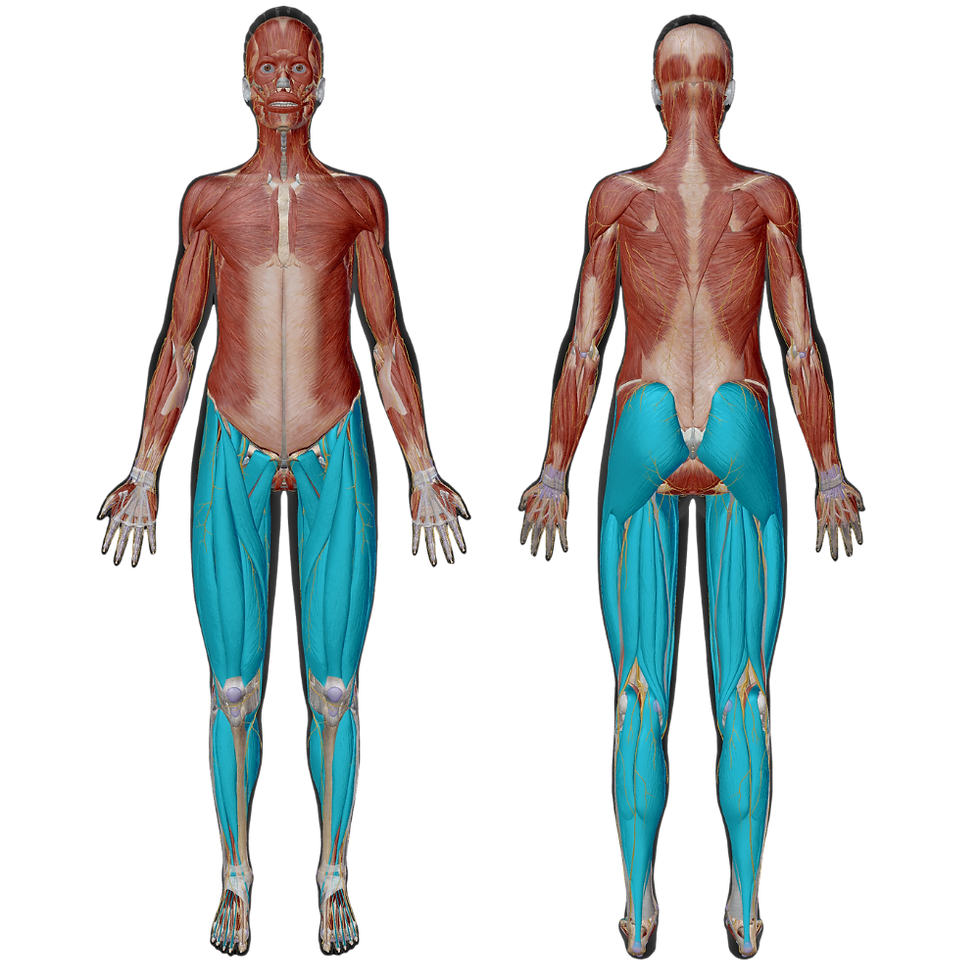
There’s no moment to reorganise. The whole system has to stay smooth and connected while you keep moving.
When one part doesn’t pull its weight, another has to step in.
That’s where small inefficiencies start to creep in.
Why Gait Matters
Most movements give you time.
You set up, perform the rep, then stop and reset.
Gait doesn’t.
It happens under fatigue, distraction, and constantly changing conditions. It adapts to different surfaces, shoes, speeds, and whatever you’re carrying. And it repeats quietly, thousands of times a day.
Because of that repetition, even small changes matter.
A slightly shorter stride. An uneven weight shift. A subtle difference between left and right.
On their own, they’re barely noticeable. Over time, they add up. What starts as a small adjustment can slowly turn into stiffness, imbalance, or that nagging discomfort you can’t quite explain.
This is why gait often serves as a quiet indicator of overall health and function.
It shows how everything else in your body is working together in real life.
Gait as a Window into Your System

Walking is often called the most natural human movement, and in many ways, it is.
It’s the first pattern we develop and the one we repeat most throughout life. It needs no instruction, no special equipment, and no gym.
But natural doesn’t always mean optimal.
Your gait reflects what your body has adapted to repeat most often.
When walking feels stable and smooth, it usually means your balance, coordination, and force transfer are working well.
When something feels off, it’s rarely random.
It’s often your body quietly compensating for something elsewhere.
Because you repeat it so many times every day, gait becomes one of the clearest real-world feedback loops you have.
Small shifts don’t stay small.
They accumulate.
How the Body Adapts and Compensates
Your body is wired to keep you moving, no matter what.
If one side feels less stable, you might unconsciously spend less time on it. If your hips don’t extend fully, your stride shortens. If rotation is limited, the body redirects movement elsewhere.
These adjustments are smart in the short term.
But repeated day after day, the extra load starts to build.
And it builds in places that weren’t designed to carry it.
That’s often how unexplained hip, knee, or lower back discomfort slowly appears.
Everyday Factors That Shape Your Gait
Gait isn’t fixed.
It responds constantly to real life.
Uneven ground demands more adaptability than flat pavement. Footwear can help or hinder. Fatigue changes coordination. Carrying a bag introduces asymmetry. Even distraction affects how well you move.
Your gait is always adjusting.
The question is whether it can do so without losing efficiency.
Try This — A Simple Observation
Next time you’re walking at your normal pace, don’t try to change anything.
Just notice:
Does one side feel different from the other?
Is the weight shift smooth, or slightly uneven?
Do your arms swing naturally, or do they feel restricted?
Pause for a second and stand on one leg.
That moment is a snapshot of what happens with every step.
Then walk again while holding something in one hand.
Notice how your body adapts.
Does it feel easy, or does something have to work noticeably harder?
These aren’t tests.
They’re simply ways to start paying attention.
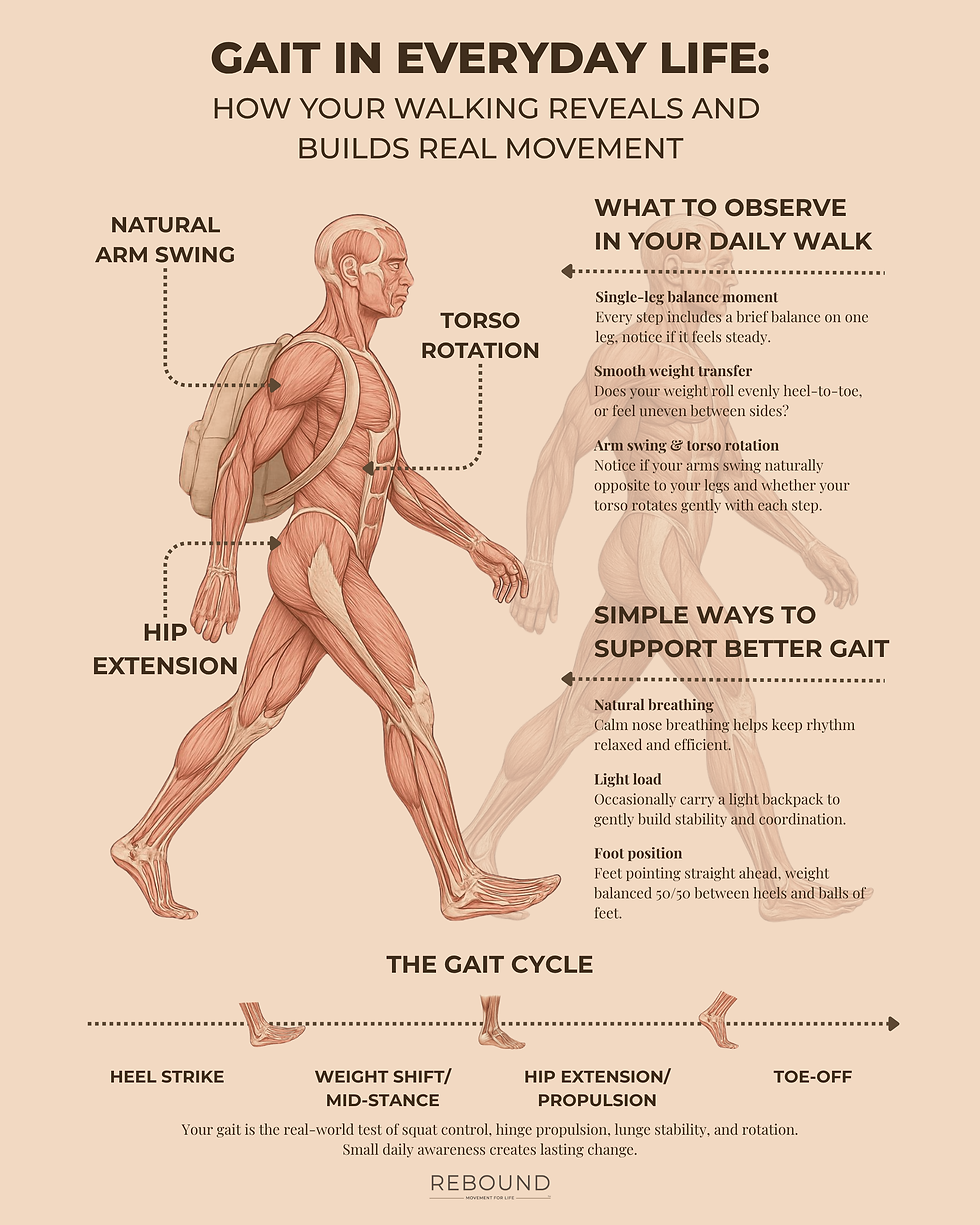
Once you've spent a few days simply noticing how your walk feels, this visual guide can help you understand the key mechanics at play (single-leg balance, smooth weight transfer, torso rotation, and hip extension) and gives you gentle, practical ways to support smoother movement in daily life.
Where This Fits in Rebound
Gait isn’t something you train directly like a squat or a hinge.
It’s where everything else comes together.
The squat builds control. The hinge provides propulsion. The lunge develops single-leg stability. Push, pull, and rotation organise the upper body.
Gait is what shows how well all of it works, when you’re not thinking about it.
Why It Matters Over Time
Because you do it every day, gait becomes an ongoing feedback loop.
A smoother, more confident walk often reflects better balance, mobility, and coordination.
In health settings, even simple things like walking speed are used to gauge overall capacity and long-term resilience.
Walking isn’t just transportation.
It’s a continuous expression of how your body is functioning.
Movement isn’t only what you practise in training.
It’s what your body repeats, day after day, even when you’re not paying attention.
That’s gait.

Comments